
Quick Answer
Both Japanese and Traditional Chinese Acupuncture share ancient East Asian roots, but they have developed into distinct clinical styles. Japanese acupuncture uses thinner needles, shallower insertion, and a heavy emphasis on touch-based diagnosis. Traditional Chinese Acupuncture (TCM) uses thicker needles inserted more deeply, targets a strong needle sensation called de qi, and integrates herbal medicine and cupping. Neither is better; they simply suit different patients and conditions.
Two Traditions, One Origin
If you search for acupuncture in your area, you may notice clinics advertising Japanese-style or Traditional Chinese Medicine (TCM) acupuncture. For most people, those words are easy to overlook. But if you are weighing your options, or if a practitioner has recommended one style over another, understanding the real differences can help you make a more confident decision.
Both traditions trace their roots to classical Chinese medical texts, specifically the Huangdi Neijing, written roughly 2,000 years ago (source: bhacu.com). When these texts reached Japan in the 6th century AD, Japanese practitioners began adapting and refining the techniques to suit their own medical culture, philosophy, and circumstances (source: acuseitai). Over the following centuries, the two traditions quietly diverged into the distinct styles practiced today.
This article breaks down how they differ in needles, diagnosis, sensation, philosophy, and practical application so that you can choose with confidence.
Needle Size and Insertion
Japanese Acupuncture Needles
Japanese needles are notably finer, often described as hair-thin. They are inserted very shallowly, typically just 1 to 5 millimetres into the skin, targeting the superficial tissues and the dense network of nerve endings just below the surface. The goal is precise, gentle stimulation rather than depth.
A distinctive feature of Japanese acupuncture is the kanshinho, or guide tube technique, pioneered by Waichi Sugiyama in the 17th century. A small plastic or metal tube steadies the needle and allows it to be tapped lightly into place, making the insertion nearly painless. This technique is now widely used worldwide.
Traditional Chinese Acupuncture Needles
Chinese needles are thicker and designed to be inserted more deeply, often reaching 10 to 40 millimetres or more, depending on the location and condition being treated. Chinese practitioners typically insert needles freehand, relying on tactile skill and patient feedback to guide depth and angle.
Once the needle is in place, the practitioner may gently lift, thrust, or rotate it to amplify the treatment effect. The needles themselves often have a slightly rougher surface at a microscopic level, which helps intensify the sensation.
The De Qi Sensation: Chasing It vs. Avoiding It
One of the most meaningful differences between the two styles is their relationship to de qi, sometimes written as 'arrival of qi.' This is the dull, heavy, or tingling sensation that signals the needle has engaged with the body's energy pathways.
In Traditional Chinese Acupuncture, de qi is considered essential. Practitioners actively work to elicit it because current research and traditional theory both suggest that this sensation is associated with better treatment outcomes. Some patients describe it as a dull ache, warmth, or electrical tingling that radiates from the needle site.
Japanese acupuncture generally takes the opposite view. The priority is patient comfort and nervous system regulation. Practitioners aim to keep stimulation minimal, partly because the technique is designed to work through the superficial nerve pathways rather than through deep tissue. In some cases, a Japanese practitioner will perform contact needling, resting the needle lightly on the skin without piercing it at all, and still achieve a therapeutic effect.
As one Japanese-trained practitioner explains: the goal is to bring the patient's body into a calm, receptive state. The less stimulation needed to get there, the better.
How Each Style Diagnoses Patients
Traditional Chinese Acupuncture Diagnosis: Pulse, Tongue, and Symptoms
A Traditional Chinese Acupuncture session typically begins with a structured intake process. The practitioner will take a detailed health history, assess your pulse at three positions on each wrist, and examine your tongue for colour, coating, and shape. They may also check your eyes, nails, or complexion.
This information is used to identify a pattern of disharmony. Common TCM diagnoses include Liver Qi Stagnation, Spleen Qi Deficiency, and Kidney Yin Deficiency. The treatment then follows a point prescription designed to address that specific pattern.
Japanese Acupuncture Diagnosis: Hara, Touch, and Real-Time Feedback
Japanese practitioners also assess the pulse and discuss symptoms, but diagnosis is primarily based on hara diagnosis, a detailed abdominal palpation. Different regions of the abdomen correspond to specific organ systems, and by pressing and feeling those areas, the practitioner maps out which systems are imbalanced.
The skin's temperature, texture, and tone, whether it feels tight or soft, warm or cool, dry or moist, all provide diagnostic information. Practitioners may also palpate specific points along the arms, legs, and back.
One important feature of Japanese acupuncture is that diagnosis continues throughout the session. The practitioner keeps one hand on the body at all times, using the oshide, or sensing hand, to monitor the body's response to each needle in real time. If the hara reflex in a specific area softens after a point is needled, that is taken as confirmation that the treatment is working.
Moxibustion: A Shared Tool, Two Different Approaches
Both traditions use moxibustion, the therapeutic burning of dried mugwort (Artemisia vulgaris), to warm acupuncture points and stimulate circulation. But the techniques differ in scale and precision.
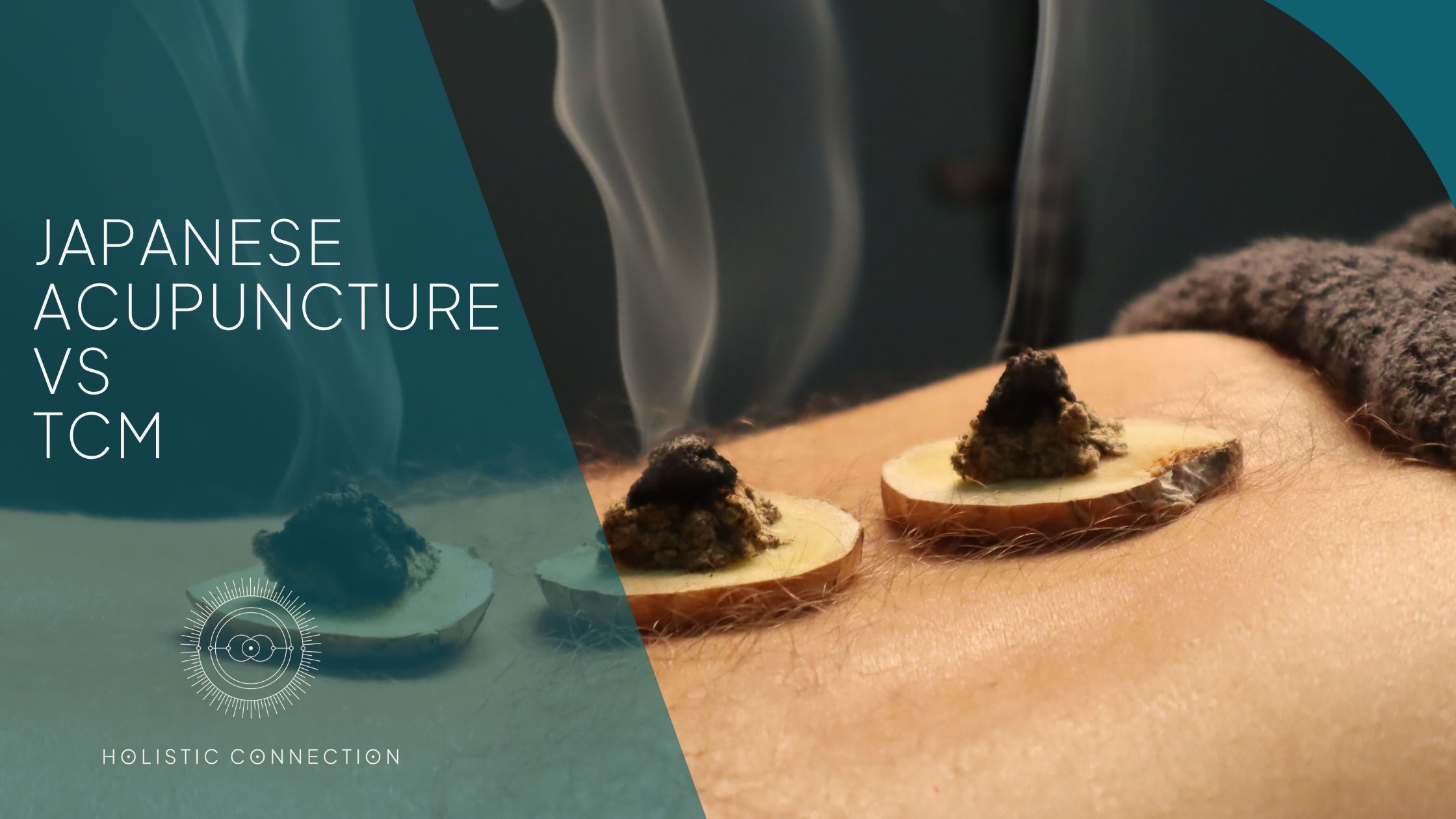
In Traditional Chinese Acupuncture, moxibustion is often applied using moxa sticks held above the skin, or with moxa cones placed on ginger or salt. Electroacupuncture and cupping are also commonly used alongside needling in TCM treatment.
Japanese moxibustion tends to be smaller and more precise. Thread moxa and rice-grain moxa use tiny quantities of mugwort applied directly to specific points, producing a gentle, localized heat. Warm needle moxibustion, called kyutoshin, involves placing a small cone of moxa at the end of an inserted needle and lighting it, combining heat and needling in a single technique.
Japan also developed shonishin, a non-insertive pediatric style that uses smooth tools to stroke, press, and tap the skin. This technique is particularly useful for children or needle-averse patients.
Treatment Philosophy: Condition-Led vs. Balance-Led
Traditional Chinese Acupuncture is often described as condition-led. The practitioner identifies the presenting complaint and a corresponding TCM pattern, then applies a point prescription designed to address it. Treatments are systematic and often more standardized across similar conditions, though a skilled TCM practitioner will always individualize based on the patient.
Japanese acupuncture is generally balance-led. Before addressing the specific complaint, the practitioner first works to correct any underlying imbalance in the body's energy distribution. The idea is that once the body's overall state is regulated, it becomes better able to respond to treatment and heal itself. Only then does the session shift toward the local or symptomatic issue.
This approach reflects a broader philosophical emphasis in Japanese medicine on treating the whole person rather than just the presenting problem.
Japanese vs. Traditional Chinese Acupuncture: Side-by-Side Comparison
| Feature | Japanese Acupuncture | Traditional Chinese Acupuncture (TCM) |
|---|---|---|
| Needle thickness | Ultra-fine, hair-thin | Thicker, more robust |
| Insertion depth | Shallow: 1–5 mm | Deeper: 10–40 mm (or more) |
| Insertion method | Guide tube (kanshinho) | Freehand insertion |
| De qi sensation | Minimal or none | Strong, intentional |
| Diagnosis focus | Palpation (hara, pulse, body touch) | Pulse, tongue, symptoms |
| Treatment philosophy | Balance first, then address the condition | Address the presenting condition |
| Moxibustion style | Thread/rice-grain moxa, precise | Larger moxa, broader application |
| Herbal medicine | Referred to Kampo specialists | Integrated into TCM treatment |
| Best for | Sensitive patients, first-timers, children | Complex conditions, robust constitution |
What Conditions Do They Treat?
Both styles address a wide range of conditions, with substantial overlap. Neither style is categorically superior in all situations. Acupuncture research, across styles, generally provides meaningful evidence for chronic pain, headache, neck pain, low back pain, knee osteoarthritis, and postoperative pain. The US National Center for Complementary and Integrative Health (NCCIH) also notes potential benefits for tension-type headaches, migraine prevention, and joint pain reduction in people receiving certain cancer treatments.
Common conditions addressed by both styles include:
Chronic and acute pain (back, neck, joint, headaches)
Stress, anxiety, and sleep difficulties
Digestive issues
Women's health concerns (menstrual irregularities, fertility support, pregnancy-related symptoms)
Fatigue and immune support
Post-surgical recovery
Where they may differ is in how they approach those conditions. Japanese acupuncture may be particularly well-suited to patients with chronic, complex, or diffuse conditions that do not fit neatly into a single-symptom framework. The integration of Traditional Chinese Acupuncture with herbal medicine may benefit patients whose conditions respond well to combined treatment.
Which Style Is Right for You?
There is no single correct answer, and the practitioner's individual skill and training matter as much as the style they practise. That said, a few practical factors can help guide your decision.
Consider Japanese acupuncture if:
You are new to acupuncture and uncertain about needles
You have a low pain threshold or needle sensitivity
You have a child or a sensitive patient who needs a gentler approach
Your condition is diffuse, chronic, or involves systemic imbalance
You want a practitioner who stays with you throughout the treatment
Consider Traditional Chinese Acupuncture (TCM) if:
You prefer a stronger, more active sensation during treatment
Your condition has a clear TCM pattern, and you want a structured approach
You would benefit from integrated herbal medicine, cupping, or electroacupuncture
You have been treated successfully with TCM before and know what to expect
In practice, many well-trained acupuncturists draw from both traditions. It is entirely reasonable to ask a prospective practitioner what styles they trained in, how they approach diagnosis, and what a typical session looks like. A good practitioner will welcome those questions.
Note: Acupuncture is generally considered safe when performed by a trained and licensed practitioner using sterile single-use needles. If you have a specific health condition, consult your primary care provider before beginning treatment.
Ready to Try Acupuncture?
Whether you are drawn to the gentle precision of Japanese acupuncture or the robust approach of TCM, finding a qualified practitioner is the most important first step. Ask about their training, their diagnostic approach, and whether they offer an initial consultation.
Frequently Asked Questions
Is Japanese acupuncture less painful than Traditional Chinese Acupuncture?
Generally, yes. Japanese acupuncture uses finer needles inserted more shallowly, and practitioners deliberately minimize sensation. Most patients report little to no discomfort. Traditional Chinese Acupuncture aims for a de qi sensation that some patients find intense, though it is not typically described as sharp pain. Individual experience varies, and a skilled practitioner in either style can adjust to your comfort level.
Which style of acupuncture is more effective?
Neither style is objectively superior. Both have strong clinical traditions and a growing evidence base for chronic pain, headaches, and stress-related conditions. Effectiveness depends heavily on the practitioner's skill, the patient's condition, and how well the approach matches the patient's needs. In some cases, the style matters less than whether the practitioner is well-trained and experienced.
Can I receive Japanese and Traditional Chinese Acupuncture from the same practitioner?
Yes. Many practitioners train in multiple styles and adapt their approach to the patient and condition. It is common for a clinician to blend techniques from Japanese and TCM traditions within a single session or across a course of treatment.
What is a hara diagnosis in Japanese acupuncture?
Hara diagnosis is a palpation-based assessment of the abdomen used in Japanese acupuncture. Different regions of the abdomen correspond to different organ systems. By pressing, feeling, and mapping these areas, the practitioner identifies imbalances and guides the treatment. It is a highly tactile skill that developed in part because acupuncture in Japan was historically performed by blind practitioners.
Does Japanese acupuncture use herbal medicine?
Not typically as part of the acupuncture session itself. When herbal treatment is appropriate, Japanese acupuncturists generally refer patients to specialists in Kampo, the traditional Japanese herbal medicine system, which is practised separately by practitioners with pharmacy-level training.
What is de qi, and why does it matter?
De qi (also written as deqi or da qi) refers to the sensation of 'arrival of qi' when a needle engages with the body's energy pathway. It is often described as a dull, heavy, or warm sensation radiating from the needle site. In Traditional Chinese Acupuncture, eliciting de qi is considered important for treatment efficacy. Japanese acupuncture generally does not seek this sensation, preferring minimal stimulation.
Is one style better for specific conditions, such as pain or fertility?
Both styles are used for pain management and fertility support, and both have practitioner communities with deep experience in these areas. The choice often comes down to the patient's sensitivity, prior experience, and access to a skilled practitioner in that style. For highly sensitive patients or those who are needle-averse, Japanese acupuncture is often the more comfortable starting point.
Have More Questions About Acupuncture?
Explore our full acupuncture resource library, or book a consultation with one of our practitioners to discuss which approach suits your health goals.
Sources:
National University of Health Sciences — How Chinese, Korean, and Japanese Acupuncture Differ https://www.nuhs.edu/how-chinese-korean-and-japanese-acupuncture-differ/
BH Acuhealth — Japanese vs. Traditional Chinese Acupuncture Explained https://bhacu.com/acupuncture-blog/explaining-unique-healing-modalities-japanese-vs-chinese-acupuncture/
Healing Mantra Acupuncture and Herbal Clinic — Japanese vs. Chinese Needle Techniques: Key Differences https://www.healingmantrapdx.com/2025/08/20/japanese-vs-chinese-needle-techniques-key-differences/
Acuseitai — Japanese vs. Traditional Chinese Acupuncture https://www.acuseitai.com/treatment-modalities/japanese-vs.-chinese.html
Bayshore Acupuncture / Saguaro Clinic — Chinese & Japanese Acupuncture: Two Traditions, One Lineage https://bayshoreacupuncture.com/chinese-japanese-acupuncture-two-traditions-one-lineage/
PubMed Central / NIH — History and Progress of Japanese Acupuncture https://pmc.ncbi.nlm.nih.gov/articles/PMC2887322/